

Sending your child off to college is an exciting milestone—but it can also be an expensive one. By the time you’ve checked everything off the move-in list, your student may be taking thousands of dollars’ worth of belongings to campus, from laptops and bicycles to gaming systems, furniture, clothing, and textbooks. Some students will even have a vehicle with them.
The last thing any family wants is to find out after a theft, fire, or accident that their insurance didn’t provide the coverage they expected.
Many parents assume their homeowners insurance automatically follows their student to college. In some situations, that’s true, but it really depends on where the student lives and the type of coverage they have.
Whether your student is moving into a residence hall, renting an off-campus apartment, or taking a car to school, now is the perfect time to review your insurance coverage. Let’s dive in before move-in day so you can avoid costly surprises later.
Topics Covered
- College Student Insurance at a Glance
- Living in a Dorm: Does Your Insurance Follow Your Student?
- A Dorm Loss Is Not Automatically the College’s Responsibility
- What About Liability in a Dorm?
- Living Off Campus: Why the Insurance Conversation Changes
- Every Roommate Needs to Understand Their Coverage
- Actual Cash Value Versus Replacement Cost
- Taking a Car to College
- Common Coverage Gaps Parents Overlook
- Create a College Home Inventory
- Back-to-College Insurance Checklist
- Review Coverage Before Move-in Day
College Student Insurance at a Glance
- A student living in a dorm may have some coverage under a parent’s homeowners or renters policy.
- Coverage away from home may be subject to lower limits, deductibles, and exclusions.
- A college, landlord or property management company generally does not insure the student’s personal belongings.
- Students living in off-campus apartments or rental houses should consider renters insurance.
- Every roommate should understand whose belongings and liability are covered.
- Your auto insurer should know where your student’s vehicle will be kept during the school year.
- A home inventory can make it easier to determine how much coverage is needed and document a future claim.
Living in a Dorm: Does Your Insurance Follow Your Student?
Many homeowners and renters insurance policies extend some coverage to dependent students living in college-owned housing.
The National Association of Insurance Commissioners advises that students under age 26 living on campus may be covered under a parent’s policy, but the amount of coverage can be limited.
Check your policy’s eligibility requirements, coverage limits, and exclusions rather than assuming everything in your student’s dorm room is protected.
Depending on your policy, coverage may extend to personal belongings such as:
- Clothing
- Furniture
- Laptops and tablets
- Televisions
- Gaming systems
- Textbooks
- Bicycles
- Small appliances allowed by the school
However, the same deductible that applies to a claim at home may also apply to property taken to college, depending on your policy. Consider a student whose $900 laptop is stolen from a dorm room. If your homeowners policy provides off-premises coverage but has a $1,000 deductible, the loss would fall below your deductible. The laptop might technically be covered, but the policy would not produce a claim payment.
That’s why it’s important to understand both your coverage and your deductible before your student heads to campus.
Ask How Much Off-premises Coverage is Available
Your policy may not provide the same amount of personal property coverage in a dorm that it provides at the family home. Some policies place a separate limit on property located away from the insured residence.
Ask your insurance agent:
- Is my student still insured under my policy?
- Does coverage apply while the student lives in a dorm?
- What is the limit for belongings away from home?
- Does my regular policy deductible apply?
- Are there special limits for electronics, jewelry, musical instruments, or bicycles?
- Does coverage apply during summer break or study-abroad programs?
Don’t rely on a general statement that your student is “covered.” Instead, ask exactly what’s covered, how much coverage you have and under what circumstances it applies.
A Dorm Loss Is Not Automatically the College’s Responsibility
It’s easy to assume the college will replace property that’s stolen or damaged in campus housing. Unfortunately, that’s generally not the case.
The NAIC notes that insurance maintained by a school, landlord or property management company does not cover a student’s personal items.
Imagine a pipe bursts above a dorm room during winter break. Water damages the student’s clothing, bedding, textbooks, and computer equipment. The college may repair the building, ceiling, and plumbing, but that does not mean it will replace everything the student owned.
Instead, you’ll need to look at your own insurance coverage. Whether the loss is covered will depend on your policy’s terms and conditions.
What About Liability in a Dorm?
Insurance isn’t just about replacing belongings. If your student accidentally injures someone or damages another person’s property, liability coverage may also come into play.
For example, imagine your student leaves a sink running while stepping out of the room. The water overflows and damages the room below. Depending on the circumstances and your policy language, personal liability coverage under your homeowners or renters policy may help respond if your student is found responsible for the damage.
Guests can get hurt, too. Suppose a friend trips over a charging cable in the dorm room and needs medical attention. Some homeowners and renters policies include Medical Payments to Others coverage, which may help pay for relatively minor medical expenses regardless of fault, subject to your policy’s limits and exclusions.
Medical Payments to Others coverage isn’t the same as personal liability coverage. Medical payments coverage is generally designed to help with smaller injuries to guests, regardless of who was at fault. Personal liability coverage may come into play if you’re legally responsible for someone’s injuries or property damage. Because these coverages serve different purposes, it’s a good idea to review both with your insurance agent.
Living Off Campus: Why the Insurance Conversation Changes
Moving off campus is an exciting milestone, but it can also change your student’s insurance needs. If your student is renting an apartment or house, don’t assume your homeowners insurance provides the same protection it may have while they were living in a dorm.
Families with students living off campus ought to consider renters insurance when a parents’ homeowners policy doesn’t apply to the rented property. Similarly, the National Association of Insurance Commissioners (NAIC) recommends renters insurance for college students living in apartments or rental houses to help protect their personal belongings.
Depending on your policy, renters insurance may provide three broad types of protection:
- Personal property coverage
- Personal liability coverage
- Additional living expense coverage
The exact protection depends on your policy, so it’s important to understand what your coverage includes before your student moves in.
Personal Property Coverage
Personal property coverage may help repair or replace your student’s belongings if they’re damaged or stolen because of a covered loss.
Imagine your student is sharing a rental house with three roommates. A cooking fire damages the kitchen and sends smoke throughout the home. One student loses clothing, furniture, a laptop, and other personal belongings.
The landlord’s insurance generally covers the building but not your student’s personal property. Depending on your policy, renters insurance may help cover damaged belongings, subject to your deductible, coverage limits, exclusions, and the cause of the loss.
Personal Liability Coverage
Personal liability coverage may also help if your student is held responsible for injuring someone or accidentally damaging another person’s property.
For example, imagine your student has friends over to their off-campus apartment. A guest slips on a wet kitchen floor and is injured. Depending on your policy and the circumstances, renters liability coverage may help if your student is found legally responsible.
Liability protection can also be important if your student accidentally damages the rental property itself. However, renters insurance doesn’t cover every type of damage or every situation. Intentional damage, certain pet-related incidents, and other excluded losses generally aren’t covered, so it’s important to understand what’s included in your policy before your student moves in.
Additional Living Expenses
A covered fire or other serious loss could make your student’s apartment temporarily uninhabitable. Depending on your policy, additional living expense coverage may help pay for the added cost of temporary housing, meals, and other necessary expenses while repairs are being made.
For example, imagine a fire forces your student out of their apartment for three weeks. They need to stay in a hotel and spend more money on meals while they’re displaced. Depending on your policy and the circumstances of the loss, additional living expense coverage may help with those increased costs, although it typically won’t pay every expense in full.
Every Roommate Needs to Understand Their Coverage
Roommates often split the rent, utilities, and grocery bills, but they shouldn’t assume they automatically share insurance coverage.
A renters policy typically protects the people named – or otherwise defined as insureds – on that policy. One roommate’s coverage may not extend to another roommate’s laptop, furniture, clothing, or personal liability.
Imagine your student is sharing a four-bedroom rental house. A burglary occurs, and the thief steals electronics belonging to three different roommates. If only one resident has renters insurance, the other students shouldn’t assume that policy will replace their belongings.
Before signing a lease, ask your insurance agent these questions:
- Does the lease require renters insurance?
- Who needs to be named on the policy?
- Does each roommate need a separate policy?
- How would shared property be covered?
- Do pets or other household risks affect eligibility?
- What liability limit is appropriate?
Having separate policies can also make the claims process easier because each student is responsible for documenting and insuring their own belongings. Since coverage options vary, talk with your insurance agent about the arrangement before your student moves in.
Actual Cash Value Versus Replacement Cost
If your student is renting an apartment, you may have the option to choose between actual cash value and replacement cost coverage on a renters insurance policy. Understanding the difference can make a big impact if you ever have to file a claim.
Actual cash value takes depreciation into account. In other words, it pays what an item is worth today, not what it cost when it was new. For example, a five-year-old laptop that originally cost $2,000 may only be worth about $500 today.
Replacement cost coverage, on the other hand, is designed to help pay for a comparable new item, subject to your policy’s terms, limits, and deductible. Using the same example, replacement cost coverage could help cover the cost of buying a similar new laptop rather than reimbursing only its depreciated value.
Before choosing a policy, ask your insurance agent how claims are settled and whether the additional cost for replacement cost coverage makes sense for your situation.
Taking a Car to College
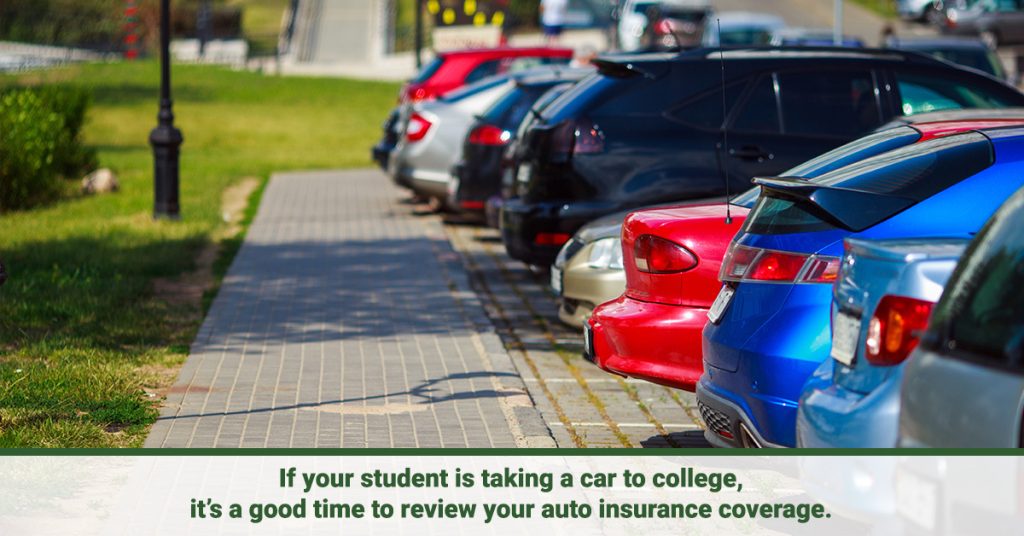
If your student is taking a car to college, it’s a good time to review your auto insurance coverage, especially if they’ll be attending school far from home or in another state.
The National Association of Insurance Commissioners (NAIC) recommends telling your insurance agent where the vehicle will be kept if it’s stored somewhere other than the address listed on your policy. The NAIC also notes that a student may be able to remain on a parent’s policy when the parent owns the vehicle. If your student owns the vehicle and holds the title, however, they may need their own policy.
Before your student heads to campus, ask your insurance agent:
- Who owns and holds the title to the vehicle?
- Who is listed as a driver?
- Where will the vehicle be garaged most of the year?
- Is the college in another state?
- Will roommates or friends ever drive the car?
- Does the policy include collision and comprehensive coverage?
- Does your student qualify for a Good Student Discount or a student-away-at-school discount?
Collision coverage generally helps pay for damage to your vehicle after a collision, subject to your deductible. Comprehensive coverage generally applies to certain non-collision losses, such as theft, vandalism, hail, falling objects, or damage caused by hitting an animal. Liability coverage, on the other hand, helps pay for damage or injuries you cause to others, and it doesn’t pay to repair your own vehicle.
Real-World Example: Damage in a Campus Parking Lot
Imagine your student walks back to their car after class and finds a deep dent in the driver’s side door. There’s no note, and whoever caused the damage is long gone.
Whether your insurance helps cover the repairs depends on several factors, including your policy, your deductible, your state and how the claim is handled. Liability-only coverage generally won’t pay to repair your own vehicle. Depending on the circumstances, collision coverage may help with certain hit-and-run property damage claims.
If your student is taking a car to college, talk with your insurance agent before move-in day so you understand exactly what your policy does and doesn’t cover.
Common Coverage Gaps Parents Overlook
Even if your student has insurance, there may still be gaps in coverage. Here are a few areas worth reviewing with your insurance agent before move-in day.
High-Value Belongings
Expensive jewelry, professional camera equipment, musical instruments, collectibles, and high-end bicycles may be subject to special coverage limits. If your student is bringing valuable items to school, ask whether additional scheduled coverage or an endorsement makes sense.
E-Bikes and Motorized Transportation
An e-bike, electric scooter or similar device may not be treated the same as a traditional bicycle. Coverage can depend on factors such as the vehicle’s speed, power and how your policy defines motorized vehicles. If your student is bringing an e-bike or scooter to campus, ask your insurance agent how it’s covered rather than assuming it’s included.
Business Property
Does your student run a small business, sell products online or do freelance work? Business equipment, inventory, and liability may have limited or no coverage under a personal homeowners or renters policy.
Gradual or Preventable Damage
Insurance is generally designed to cover sudden, accidental losses—not routine wear and tear, neglect, maintenance issues, or damage that develops over time.
Flood Damage
Standard homeowners and renters policies generally don’t cover flood damage caused by rising surface water. If your student will be living in a basement apartment, a garden-level unit, or another flood-prone area, ask whether additional flood protection is worth considering.
Create a College Home Inventory
Creating a home inventory is one of the easiest ways to prepare for the unexpected. Documenting your belongings to help determine how much insurance you need and making the claims process easier if you ever experience a loss, is a good idea.
Before move-in day:
- Photograph your student’s dorm room or apartment and everything in it.
- Record serial numbers for laptops, televisions, bicycles, and other electronics.
- Save digital copies of receipts whenever possible.
- Note the approximate purchase date and replacement cost of valuable items.
- Store your inventory somewhere other than your student’s laptop or phone, such as cloud storage or an external drive.
- Update your inventory whenever your student makes a major purchase.
If your student ever experiences a covered loss, you’ll have a much clearer record of what was owned and what it may cost to replace.
Back-to-College Insurance Checklist
Before your student leaves for campus, take a few minutes to review the following:
- Confirm that your student qualifies as an insured under your homeowners or renters policy.
- Verify coverage for belongings kept in a dorm room.
- Ask about off-premises coverage limits.
- Review your homeowners or renters deductible.
- Consider whether your student needs a separate renters insurance policy for off-campus living.
- Check coverage limits for electronics, jewelry, musical instruments, and bicycles.
- Compare actual cash value and replacement cost coverage.
- Create a photo and video inventory of your student’s belongings.
- Record model and serial numbers for valuable items.
- Make sure every roommate has appropriate renters insurance.
- Tell your auto insurance company where your student’s vehicle will be kept during the school year.
- Confirm vehicle ownership and driver listings.
- Review your liability limits.
- Ask about available student discounts.
- Keep your policy numbers and claims contact information somewhere that’s easy to access.
Review Coverage Before Move-in Day
Your student’s insurance needs may change throughout their college years. A freshman living in a dorm may have different coverage needs than a junior renting a house with three roommates. Those needs can change again if your student buys a car, adopts a pet, studies abroad or starts a small business.
That’s why it’s a good idea to review your insurance coverage before each school year. A quick conversation with your insurance agent can help you identify changes, close potential coverage gaps, and make sure your protection still fits your student’s situation.
Need to learn more about your student’s insurance coverage?
Our agents are ready to help, so contact us to learn how we can customize your insurance policies to meet your needs.
*Disclaimer: We offer content for informational purposes; Co-operative Insurance Companies may not provide all the services or products listed here. Please get in touch with your local agent to learn how we can help with your insurance needs.
Sources
National Association of Insurance Commissioners. Back to School: Know Your Insurance Needs Before You Get to Campus. https://content.naic.org/article/consumer-insight-back-school
National Association of Insurance Commissioners. Do I Need Renters Insurance for College? https://content.naic.org/article/do-i-need-renters-insurance-college
National Association of Insurance Commissioners. Renters Insurance for College Students. https://content.naic.org/article/consumer-insight-renters-insurance-college-students
Insurance Information Institute. Protecting Your College Student From On-Campus Losses. https://www.iii.org/article/do-i-need-insurance-child-going-away-college
Insurance Information Institute. Parents Should Study How Campus Life Impacts Their Insurance. https://www.iii.org/press-release/parents-should-study-how-campus-life-impacts-their-insurance-080719
Massachusetts Division of Insurance. College Insurance Needs. https://www.mass.gov/info-details/college-insurance-needs
Massachusetts Division of Insurance. Understanding Home Insurance. https://www.mass.gov/info-details/understanding-home-insurance