
It usually starts with something small, like a smell that doesn’t quite make sense or a flicker of light outside your window. Maybe your neighbor knocks on your door a little too late at night.
In most cases, people assume it’s an accident. Something explainable like a wiring issue or a poorly place space heater. But sometimes the fire was set on purpose, and that’s what makes people uncomfortable because it challenges the idea that risk is random or predictable. Arson reveals intent, a targeted attack.
According to the National Fire Protection Association, arson is one of the leading causes of fire-related property damage in the United States which means that it’s an ongoing reality, not an outlier.
To put that into perspective:
- More than 500,000 fires are intentionally set each year
- Those fires cause over $2 billion in property damage annually
That means arson can and does happen in neighborhoods that look and feel a lot like yours. Here’s what you need to know about arson and how to protect your home or business. Let’s dive in.
Topics Covered
- Where Arson Happens
- What Arson Actually Means
- Why the Cause of Fire Matters
- The Why Behind Arson Is More Human Than You’d Expect
- The Part That Catches People Off Guard
- Where Arson Fires Start
- Higher-Risk Situations Most People Overlook
- Recognizing When Something Isn’t Right
- What You Can Do About Arson
- What Happens After a Fire
- How Insurance Works When Arson Is Involved
- For Business Owners: The Impact Goes Beyond Your Building
Where Arson Happens
In New England, the way many properties are set up can cause issues:
- Homes built decades ago, sometimes with aging materials
- Structures close together, especially in older towns
- Detached garages, sheds, barns
- Firewood stacked right against the house during winter
None of these are problems on their own. They’re part of everyday life here. But they do mean that when a fire starts it has more opportunities to spread, and that’s where the data becomes more relevant.
Nearly 28,000 vehicles are intentionally burned each year in the U.S., often in residential areas. Many intentionally set fires begin outside structures and move inward, rather than the other way around.
The risk isn’t just inside your home or business. It’s around it as well.
What Arson Actually Means
When people hear the word “arson,” they often default to one assumption: insurance fraud.
The reality is broader. The FBI defines arson as any willful or malicious burning of property. That includes homes, businesses, vehicles, and outdoor property.
What separates arson from an accidental fire is intent, and that difference has a ripple effect across everything that follows. From an insurance standpoint, an intentional fire introduces a different process:
- The cause of the fire must be investigated
- Evidence needs to be preserved and reviewed
- Claims may take longer to resolve
This doesn’t mean your coverage disappears. If someone else causes damage to your property, your policy is usually designed to protect you. But it does mean that the path from damage to recovery can be more complex.
It’s one of those behind-the-scenes realities most people don’t think about until they’re living it.
Why the Cause of Fire Matters
To most people, a fire is a fire. The damage looks the same from the outside. But behind the scenes, determining how a fire started is one of the most important parts of the process.
Accidental fires tend to follow familiar patterns such as electrical issues, cooking mishaps, or heating equipment malfunctions. They’re investigated, documented, and typically move through the claims process in a relatively straightforward way.
Intentional fires are different. They often involve indicators like:
- Accelerants (such as gasoline)
- Multiple ignition points
- Signs of forced entry or tampering
Those indicators change how the situation is handled:
- Fire investigators take a closer look at origin and cause
- Insurance adjusters coordinate with those findings
- Timelines may extend while everything is confirmed
It’s not about making things harder, but rather about making sure the full story is revealed before decisions are made.
The Why Behind Arson Is More Human Than You’d Expect
If arson were mostly about money, it would be easier to predict, but it’s not. In fact, the most common motivation is something much more personal: revenge.
That could be a dispute between neighbors, a falling-out at work, or a relationship that ended badly. Think about situations where emotion overrides judgment. Other cases involve thrill-seeking or attempts to cover up another crime.
One of the more surprising insights is this:
- There is no strong connection between economic hardship and increased arson rates
This isn’t a pattern you can easily track or anticipate because it’s tied to behavior and behavior is unpredictable. That unpredictability is part of what makes awareness for homeowners and businesses so important.
The Part That Catches People Off Guard
One of the most sobering realities about arson is when it happens. Many people assume these fires occur in empty buildings, late at night, when no one is around, but that’s not always the case.
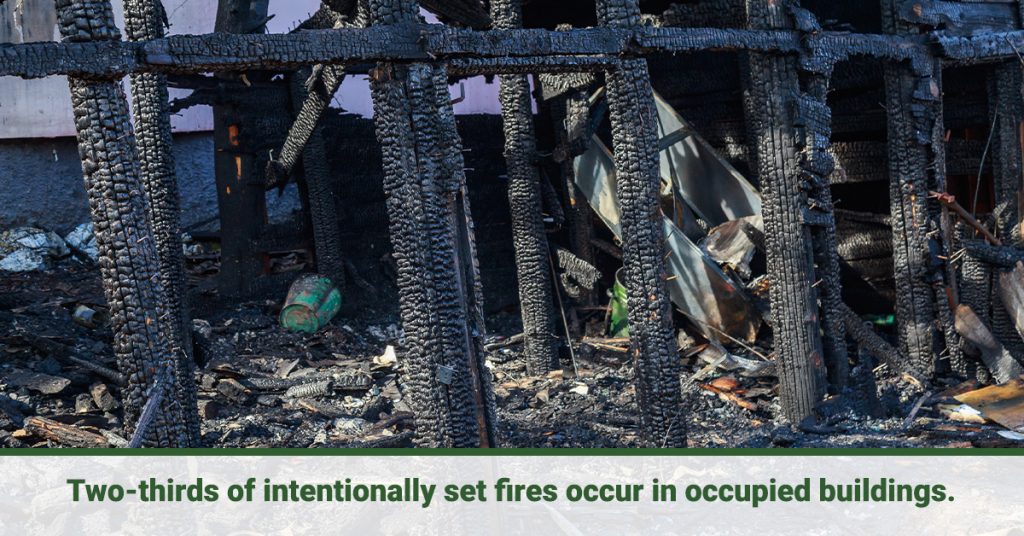
Two-thirds of intentionally set fires occur in occupied buildings. That means:
- Families are inside their homes
- Employees are at work
- People are caught completely off guard
And even when everyone gets out safely, the impact doesn’t end there.
Fires, especially those involving modern materials, can leave behind invisible damage. Smoke can carry toxic substances that settle into walls, furniture, and air systems, for example. What looks like a structure that “made it” may still be unsafe to return to for some time.
Where Arson Fires Start
One of the more counterintuitive facts about arson is where it typically begins:
- Roughly 75% of intentionally set fires start outside.
That shifts the focus away from interior hazards and toward the perimeter of your property. Common ignition sources are simple—often just matches or lighters. What matters more is what those sources are used on.
Around many homes and businesses, there are small, everyday hazards that can unintentionally create opportunities:
- Firewood stacked directly against siding or near your house
- Fuel containers or paint stored in visible areas
- Debris or materials near the structure
None of these feel risky on their own, but in the wrong situation, they can become ignition points.
Higher-Risk Situations Most People Overlook
Not every property carries the same level of exposure, and some risk factors are easy to miss because they feel normal. In New England, a few patterns tend to stand out.
Properties that are more vulnerable often include:
- Seasonal homes that sit empty for weeks or months
- Businesses that are unoccupied overnight or on weekends
- Buildings with poor lighting or limited visibility from the street
- Situations where there’s ongoing conflict (tenant disputes, neighborhood tension, or employee issues, etc.)
None of these guarantees something will happen, but they do create conditions where something could. Arson is often about opportunity, not complexity.
Recognizing When Something Isn’t Right
After a fire, determining whether it was accidental or intentional is a job for trained professionals. but there are certain patterns that tend to raise red flags during investigations. These can include:
- Signs of forced entry, like broken windows or damaged doors
- Unusual activity around the property prior to the fire
- The presence of accelerants, such as gasoline
- Items left behind, including rags, matches, or containers
If something feels off, it’s worth reporting, but it’s not something to try to piece together on your own.
What You Can Do About Arson
This is where awareness turns into action. You can’t control someone else’s intent, but you can reduce the chances that your property becomes an easy target. It starts with simple, practical decisions.
Keeping flammable materials stored properly and out of sight is one of the most effective steps you can take. From there, it’s about limiting access and improving visibility.
That often looks like:
- Locking sheds, garages, and vehicles
- Installing lighting in darker areas
- Keeping the exterior of your property clean and uncluttered
If you have children in the home, there’s another layer to consider. About half of intentional fires involve children, often driven by curiosity rather than intent. That’s why it helps to:
- Store matches and lighters securely
- Talk openly about fire safety
- Supervise outdoor fire-related activities
In a place like New England, it’s also worth thinking about seasonally. Winter brings firewood and fuel storage. Summer brings vacant homes and more outdoor activity. Risk shifts with the season and small adjustments can make a real difference.
What Happens After a Fire
What happens after a fire often surprises people. Once the fire is out and the immediate danger has passed, the situation continues to evolve. In the first couple of days, the focus is on stabilization:
- Securing the property
- Finding temporary housing if needed
- Contacting your insurance provider
But the longer-term reality is more complex. Fire damage isn’t just what you can see. Smoke can settle into everything. Water used to extinguish the fire can create additional damage. Structural safety needs to be evaluated before anyone can move back in.
If arson is suspected, the timeline can shift further:
- Investigations may delay cleanup
- Access to the property may be limited
- Decisions take longer while the cause is confirmed
Recovery becomes a longer and more stressful process.
How Insurance Works When Arson Is Involved
When a fire is believed to be intentional, the claims process includes a few additional steps. That’s not a sign of a problem, it’s part of making sure everything is handled correctly.
Typically, this may involve:
- A formal cause-and-origin investigation
- Coordination between fire officials and insurance adjusters
- Requests for documentation related to the property
These steps help establish what happened and ensure that your coverage is properly applied to your losses.
The key point is this: if someone else caused the fire, your policy is there to help protect you. The process may take longer, but the purpose is to get it right.
For Business Owners: The Impact Goes Beyond Your Building
For business owners, the effects of a fire extend well beyond physical damage. Even a small incident can disrupt operations in ways that are hard to predict. A temporary closure can last weeks or months. Revenue may stop while expenses continue. Customers may turn elsewhere in the meantime.
That’s why coverage like business interruption insurance matters, but it’s also why understanding it ahead of time is so important. A fire doesn’t just damage a space. It interrupts everything that happens inside it.
Arson isn’t something most people spend time thinking about, but it is a risk and often closer than it seems.
Understanding where that risk comes from and what you can do about it can give you a level of control over a potential situation that otherwise will feel unpredictable. The right insurance coverage can help protect your home, your business, and your livelihood.
Need to learn more about how your home or business insurance can help protect you against arson?
Our agents are ready to help, so contact us to learn how we can customize your insurance policies to meet your needs.
*Disclaimer: We offer content for informational purposes; Co-operative Insurance Companies may not provide all the services or products listed here. Please get in touch with your local agent to learn how we can help with your insurance needs.
Sources
Federal Bureau of Investigation (FBI). Crime/Law Enforcement Stats (Uniform Crime Reporting Program). https://www.fbi.gov/how-we-can-help-you/more-fbi-services-and-information/ucr
Federal Emergency Management Agency (FEMA). Protect Homes From Arson. https://www.usfa.fema.gov/prevention/arson/protecting-homes/
Federal Emergency Management Agency (FEMA). Arson and Youth Firesetting. https://www.usfa.fema.gov/prevention/arson/
MSO. Arson Facts – https://www.msonet.com
National Fire Protection Association (NFPA). Don’t Chance Safety. https://www.nfpa.org U.S. Fire Administration. Residential Fire Estimate Summaries (2014-2023). https://www.usfa.fema.gov/statistics/residential-fires/