

A denied insurance claim doesn’t usually start with a major disaster. Often, it’s something smaller like a damp spot in the basement or a slow drip behind your wall. While the damage may feel sudden once it’s discovered, it’s actually been building quietly for months.
You do what you’re supposed to do. You call your insurance company and file a claim but then comes the part that catches people off guard: “This isn’t covered.” This is frustrating but common because many homeowners haven’t been shown the gaps in their coverage.
Homeowners insurance is designed to protect you from sudden, accidental damage, not from everything that can go wrong with your house. Preventable things that develop over time or those that fall into higher-risk categories are usually excluded.
Understanding these exclusions is one of the most important parts of protecting your home. Let’s dive in.
Topics Covered
- What Are Exclusions?
- The “Slow Problem” Issue: Wear, Tear, and Maintenance
- Flood Damage: The Coverage Gap Almost No One Sees Coming
- Water Backup: Not a Flood, Still Not Covered
- Mold: Where Cause Matters More Than the Damage
- Pests, Rodents, and “Things You Could Have Prevented”
- Are High-Value Items Covered?
- Home-Based Businesses: Where Personal Coverage Stops
- Building Codes and “The Cost You Didn’t Plan For”
- Vacant Homes: When Coverage Quietly Changes
- Earth Movement: When the Ground Itself Becomes the Problem
- Certain Dog Breeds and Bite History
- Power Surges from Outside Your Property
- Intentional Damage
- Nuclear Hazards
- War
- Government Action
- It’s Not About What’s Covered — It’s About What Isn’t
What Are Exclusions?
When people hear the word exclusion, it sounds technical or like fine print designed to trip you up. It’s much simpler than that.
An exclusion is just a boundary. It defines what your policy is not responsible for, so you can better understand what you are responsible for as a homeowner. Most policies are built around a core idea:
- They cover sudden, unexpected events
- They do not cover gradual damage, maintenance issues, negligence or high-risk scenarios
That distinction often shows up across almost every exclusion. If something happens quickly, like a pipe bursting, there’s a good chance it’s covered. If it develops slowly, or could have been prevented with regular upkeep, it usually isn’t.
In some cases, the risk is simply too large or too specific to include in a standard policy, which is why separate coverage exists.
The “Slow Problem” Issue: Wear, Tear, and Maintenance
Neglect is where most claim denials happen, and it’s also one of the most misunderstood. Homes age. Materials break down. Small issues become bigger ones over time. That’s just part of owning a home.
But insurance draws a clear line here. If the damage didn’t happen suddenly, it’s usually not covered. Imagine something you don’t notice right away like a small leak behind a wall. Over weeks or months, moisture builds. Eventually, it leads to mold, rot, or even structural damage.
By the time it’s discovered, it’s a serious issue, but from an insurance perspective, it didn’t happen in a single event. It developed gradually, which means it’s considered preventable. This is one of the most common misunderstandings homeowners have about their coverage.
This category includes things like:
- Aging roofs
- Worn-out plumbing
- Corrosion
- Long-term leaks.
- Pest and rodent infestations
None of these happen suddenly and because of that, they fall outside what a standard policy is designed to handle.
What makes this tricky is that the result often feels sudden, even if the cause wasn’t. That’s why routine maintenance matters more than people realize. Not just for the home itself, but for how insurance evaluates what happened if you must file a claim.
Flood Damage: The Coverage Gap Almost No One Sees Coming
If there’s one exclusion that surprises homeowners the most, it’s water damage. Water damage feels like it should be straightforward. If your home takes on water, insurance should help, right?
The reality is that where the water comes from matters more than anything. If water comes from inside your home, like a burst pipe, that’s typically covered.
However, if it comes from outside your home and enters in, it’s classified as flooding, and standard homeowners’ insurance does not cover flood damage.
This is where homeowners may be caught off guard, especially in places like New England where heavy rain, snowmelt, and coastal storms are common.
Picture a spring thaw after a long winter. The ground is saturated, the snow melts quickly, and water starts pooling around your foundation. Eventually, it finds its way inside. It feels like a clear-cut claim, but because that water originated outside, it falls into a category that your policy excludes.
What’s important to understand is that “flood” doesn’t just mean dramatic, headline-making disasters. It can include:
- Water from heavy rain overwhelming the ground
- Runoff from melting snow
- Overflow from nearby bodies of water
- Storm surge in coastal areas
The fix isn’t complicated, but it does require awareness. Flood coverage is typically available through a separate policy, often backed by the National Flood Insurance Program (NFIP).
Many homeowners who don’t think they’re in a flood-prone area are still at risk. In fact, a considerable number of flood claims come from moderate- or low-risk zones.
Water Backup: Not a Flood, Still Not Covered
There’s another water-related issue that exists in a gray area and causes many surprises: sewer and drain backups. These aren’t floods in the traditional sense, but they’re also not always covered under a standard policy.
Unfortunately, many homeowners either don’t have this coverage at all or have limited protection. Think about a finished basement, a common feature in a lot of New England homes. It’s extra living space, maybe even where kids play or where you’ve set up a home office.
Then heavy rain hits. The municipal system gets overwhelmed and water comes back up through the drain. The damage to flooring, drywall, and furniture can be significant and without a specific endorsement, it may not be covered.
This is one of those areas where a small adjustment to your policy can make a substantial difference. Water backup coverage is typically inexpensive compared to the cost of a major cleanup.
Mold: Where Cause Matters More Than the Damage
Mold is one of the most confusing areas of homeowners insurance, mostly because it depends entirely on how it started. If mold is the result of a covered event, like a pipe that suddenly bursts, there’s a good chance remediation will be included.
However, if it develops from something gradual like a slow leak or high humidity, it usually isn’t. That distinction can feel frustrating, especially when the damage looks the same either way.
The cause of the mold determines whether it’s covered. This is another example of that core rule showing up again:
- Sudden = potentially covered
- Gradual = usually not
The best protection here isn’t just insurance — it’s awareness too. Addressing moisture early, fixing leaks quickly, and keeping humidity under control can prevent a much bigger problem down the line.
Pests, Rodents, and “Things You Could Have Prevented”
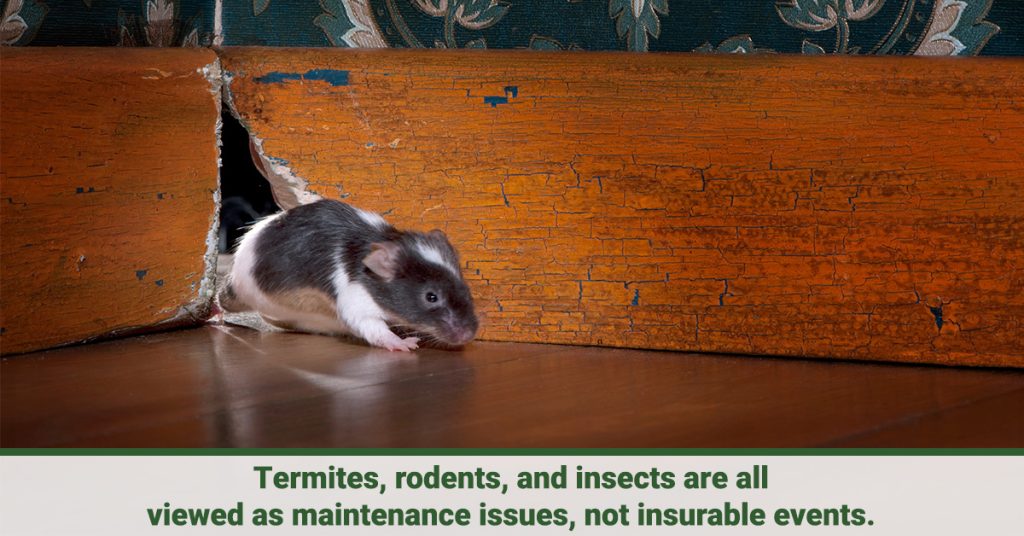
There’s probably a pattern you’ve noticed by now. If something is considered preventable, it’s excluded. That’s exactly how insurance treats pest damage.
Termites, rodents, and insects are all viewed as maintenance issues, not insurable events, so damage caused by pests is almost never covered. While that might feel frustrating, the reasoning is consistent. These issues typically develop over time and can often be reduced or avoided with regular upkeep.
It’s not about whether the damage is serious, it’s about whether it was sudden and unavoidable.
Are High-Value Items Covered?
This one is less about exclusions and more about expectations. Most homeowners’ policies do include coverage for personal belongings, but certain categories like jewelry, artwork, or collectibles have limits.
Those limits are often lower than people expect. For example, you might assume a valuable item is fully protected, only to find out there’s a cap well below its actual value.
The gap here isn’t that the item isn’t covered, it’s that it’s not covered enough.
This is where scheduling items (adding them individually to your policy) becomes important. It’s a simple step, but one that a lot of homeowners don’t take until after something happens.
Home-Based Businesses: Where Personal Coverage Stops
With more people working from home than ever, or running side businesses, this exclusion is becoming more relevant. A standard homeowners’ policy is built around personal use, not business activity. That means:
- Equipment used for business may have limited coverage
- Inventory may not be covered at all
- Liability related to business activity is usually excluded
If your home doubles as a workspace in any meaningful way, it’s worth talking to an insurance agent to learn how your policy treats that type of coverage.
Building Codes and “The Cost You Didn’t Plan For”
Here’s something that often surprises homeowners. Let’s say part of your home is damaged and needs to be rebuilt. Your insurance covers the damage, but rebuilding in today’s world isn’t the same as when your home was originally built.
Codes change, so electrical systems, insulation, and materials may need to be updated to meet current standards. Those upgrades can add significant cost, and depending on your policy, they may not be fully covered.
This is where something called “ordinance or law coverage” comes into play, and it’s one of those details most homeowners don’t think about until they need it.
Pro tip: Read “Will Your Homeowners Insurance Cover a Disaster? Maybe…” to avoid becoming among the 60% of homeowners who are underinsured due to rising building costs and inflation.
Vacant Homes: When Coverage Quietly Changes
Homes are meant to be lived in and when they’re not, your risk profile changes and so can your coverage. If a home is vacant for an extended period, insurers may reduce coverage or deny certain claims altogether.
It’s not always obvious, either. You might assume your policy is unchanged, only to find out later that vacancy conditions applied. This can come into play with:
- Seasonal homes
- Homes for sale
- Temporary relocations
It matters most when something goes wrong while no one is there to catch it early.
Earth Movement: When the Ground Itself Becomes the Problem
Most homeowners don’t think much about the ground beneath their home until something shifts. Earth movement is one of those exclusions that feels a little abstract.
It refers to damage caused by things like:
- Earthquakes
- Landslides
- Sinkholes
- Shifts in the soil over time
In insurance terms, it’s a broad category that covers any kind of sinking, shifting, or destabilizing of the earth itself, and in most standard homeowners policies, it’s not covered.
That means if the ground moves and your foundation cracks, your walls shift, or your home becomes structurally compromised, it’s typically considered outside the scope of your policy.
That said, there are a few important nuances. If ground movement leads to a secondary event that is covered, your policy may still apply in those cases. For example, if an earth movement causes a fire or explosion, the resulting damage from that fire or explosion could be covered, even if the original cause wasn’t.
There’s also an edge case that surprises people. If an earthquake damages your home and creates an opening, and someone takes advantage of that to break in and steal property, that theft may still be covered.
Insurance doesn’t always draw the line where you expect, and it often comes down to what caused the damage and what happened next.
For most homeowners, this isn’t something that comes up often. But if you live in an area where ground movement is a possibility, it’s worth asking you insurance company, “If something shifts under my home… what happens next?”
When it comes to structural damage, the costs can add up quickly and this is one of those areas where a standard policy may leave a gap.
Certain Dog Breeds and Bite History
For a lot of homeowners, pets are part of the family and most of the time, homeowners insurance reflects that. Standard policies typically include liability coverage for dog-related incidents, like bites or injuries.
However, this is one of those areas where the details matter more than people expect. If your dog has a history of biting, or in some cases belongs to a breed that insurers consider higher risk, coverage can be limited or excluded altogether. That doesn’t necessarily mean you won’t be able to get coverage, but it may mean your current policy has restrictions you’re not aware of.
If you have a dog that falls into a restricted category or has any kind of incident history, it’s worth asking your agency, “If something were to happen, am I fully covered?”
Power Surges from Outside Your Property
Not all power issues are treated the same in homeowners insurance, and where the problem starts makes a big difference.
If a power surge or outage originates off your property, like from a utility company issue or grid failure, any resulting damage typically isn’t covered under a standard policy.
If the problem starts inside your home, that’s a different story. For example, if a wiring issue or short circuit on your property leads to a surge that causes damage or sparks a fire that resulting damage would generally be covered, provided it’s not caused by wear and tear.
The important distinction to keep in mind is:
- Outside your property is usually not covered
- Inside your property is often covered
If you’re concerned about protecting appliances and electronics from external surges, this is one of those areas where additional coverage or surge protection devices can be worth considering.
Intentional Damage
Homeowners insurance is built to protect you from accidents, not intentional acts. If damage is caused on purpose by you or someone in your household, it typically won’t be covered. That includes things inside your home as well as damage to someone else’s property.
For example, if a frustrated teenager decides to take a can of spray paint to the side of your house, that’s not something insurance is going to cover.
The same idea applies to liability coverage. Your policy can help with legal or medical costs if someone is accidentally injured or their property is damaged. However, if that damage or injury was intentional, coverage doesn’t apply.
It’s a pretty straightforward:
- Accidental damage is typically covered
- Intentional damage is not covered
Nuclear Hazards
Damage caused by nuclear reaction, radiation, or radioactive contamination isn’t covered under a standard homeowners policy, regardless of how it happens.
That said, if a nuclear event leads to a secondary loss like a fire, the fire damage itself may still be covered.
War
Damage resulting from war, whether declared or undeclared, is excluded from homeowners insurance.
This includes events like civil war or large-scale conflict. Simply put, policies aren’t designed to cover widespread, catastrophic events of this scale.
Government Action
If a government or public authority damages or destroys your home or belongings — for example, during a mandated demolition or emergency response — your homeowners insurance won’t cover the loss. This falls outside the scope of what a standard policy is built to protect against.
It’s Not About What’s Covered — It’s About What Isn’t
If there’s one takeaway from all of this, it’s this: Homeowners insurance is incredibly valuable, but it’s not all-encompassing and it’s not supposed to be.
The real advantage comes from understanding where the gaps are before you need to rely on your coverage so you can make informed decisions about what additional coverage matters most for your home.
For some homeowners, that might mean adding flood coverage. For others, it’s as simple as adding water backup protection or scheduling a valuable item.
Ask yourself, “What am I assuming is covered that might not be?”
The best time to answer that question isn’t after a claim, it’s right now, so talk to one of our insurance experts today to make sure you’ve got the coverage you need.
Need to learn more about homeowners insurance?
Our agents are ready to help, so contact us to learn how we can customize your insurance policies to meet your needs.
*Disclaimer: We offer content for informational purposes; Co-operative Insurance Companies may not provide all the services or products listed here. Please get in touch with your local agent to learn how we can help with your insurance needs.
Sources
Bankrate. Homeowners Insurance Exclusions. https://www.bankrate.com/insurance/homeowners-insurance/homeowners-insurance-exclusions/
Farm Bureau Financial Services. 8 Surprising Things Your Homeowners Insurance May Not Cover.
https://www.fbfs.com/learning-center/infographic-8-surprising-things-your-homeowners-insurance-may-not-cover
Federal Emergency Management Agency. Flooding Happens Everywhere.
https://www.floodsmart.gov
Liberty Mutual. Avoid these 5 common homeowners insurance mistakes.
https://www.libertymutual.com/insurance-resources/property/homeowners-insurance-mistakes
Policygenius. What does homeowners insurance not cover? 13 common policy exclusions. https://www.policygenius.com/homeowners-insurance/home-insurance-exclusions/
U.S. News & World Report. Homeowners Insurance Exclusions
https://www.usnews.com/insurance/homeowners-insurance/homeowners-insurance-exclusions