
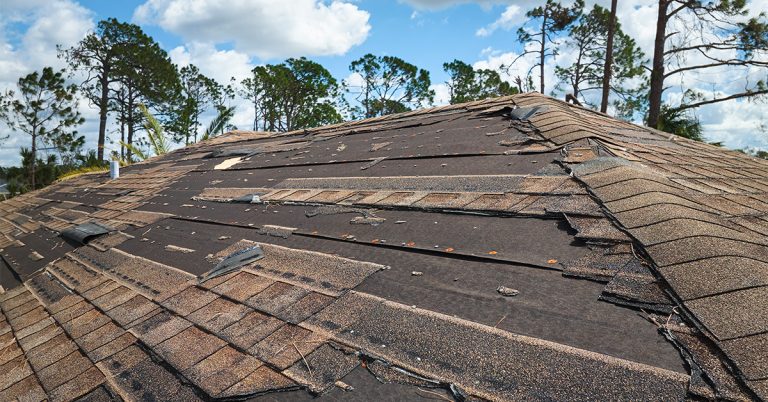
The wind is howling hard enough to wake you up. You roll over, half-awake, thinking, “It’s just wind.”
The next morning, your yard looks messy. A few branches are down, and the grill cover blew across the deck, but from the driveway your roof looks fine. Two weeks later, you notice a faint brown ring on the ceiling in your upstairs hallway.
That’s how wind damage often works. It’s not dramatic. It’s subtle. It starts at the edges, under your shingles or around your flashing, and by the time you notice water inside your home, the real damage has already begun. Let’s dive in.
Topics Covered
How Wind Damages a Roof
When most homeowners think of wind damage to their roof, they picture shingles blowing off. That happens, but sometimes there are several other ways that wind interacts with your roof.
1. Wind Uplift & Suction
When wind flows over a roof, it creates low pressure above the surface. At the same time, air pressure inside the home pushes upward. This causes a pressure difference that creates a lifting force—called uplift or suction—that can pull shingles, flashing, and even roof decking upward.
Why does this matter for homeowners? Because shingles are sealed with adhesive strips and over time, those strips weaken. When wind lifts a shingle even slightly, the seal can break. Then the next storm comes along and lifts it more easily.
Now, you have a penetration in your roof that can let water in. This is how wind events create long-term vulnerabilities.
2. Edges & Corners Take the Hardest Hit
Wind doesn’t affect your roof evenly.
Research and building codes recognize that edges, corners, and ridges experience the highest wind pressures. High-risk areas include:
- Rake edges
- Eaves
- Ridge caps
- Hip lines
- Gable ends
Ridge caps are often the first components to detach. From the street, the roof “looks fine.” But those ridge pieces are critical to keeping wind-driven rain out.
3. Lateral Pressure on Walls
Wind doesn’t just pull up—it also pushes horizontally.
Strong gusts apply lateral pressure to walls. If a wall flexes or a garage door fails, the building can become internally pressurized. That increases upward pressure on the roof from inside the structure.
4. Wind-Driven Rain
Once wind lifts or loosens a shingle, rain can penetrate under compromised roofing and cause:
- Wet insulation
- Ceiling staining
- Wood rot
- Mold growth
5. Debris Impact
Wind can carry branches, lawn furniture, and other debris that can puncture shingles or dent metal roofing.
For example, according to the National Oceanic and Atmospheric Administration (NOAA), severe thunderstorms can produce wind gusts over 58 mph, which is strong enough to move loose objects and break limbs.
The blizzard that hit New England in February of 2026 recorded windspeeds of 83 mph while dumping feet of snow across the region.
What Wind Speeds Cause Roof Damage?
How strong does wind have to be to damage your roof? While there’s no single number, there are thresholds.
According to NOAA:
- 39–57 mph: Strong breeze to near gale; small branches move
- 58+ mph: Severe thunderstorm criteria
- 74+ mph: Hurricane-force winds
The Insurance Institute for Business & Home Safety (IBHS) has conducted wind testing on roofing systems and found that improperly installed or aging shingles can begin failing well below hurricane speeds as follows:
- 45 mph gusts: Loose shingles may lift.
- 60 mph gusts: Seal strip failure becomes common.
- 70+ mph: Widespread shingle loss possible, especially on older roofs.
Age, installation quality, and exposure all matter.
A 20-year-old roof with brittle shingles is far more vulnerable than a 5-year-old roof with upgraded fastening.
Where Roofs Typically Fail First
If you’re inspecting your roof after a wind event, these are the areas most likely to show damage.
1. Shingles
Look for:
- Missing tabs
- Creased shingles (a sign of lifting)
- Granule loss in gutters
Creased shingles may not fall off immediately but once bent, they’re usually compromised.
2. Ridge Caps
Ridge caps sit at the peak—fully exposed.
Signs of damage:
- Missing cap shingles
- Exposed nails
- Cracking or curling
3. Flashing
Check around:
- Chimneys
- Skylights
- Plumbing vents
- Valleys
Wind can loosen metal flashing, allowing water to enter during the next rainfall.
4. Roof Decking
In severe events, uplift can pull nails partially out of decking.
Signs from inside the attic:
- Daylight through boards
- Water staining
- Sagging sheathing
5. Soffits & Fascia
Detached soffits can allow wind to enter the attic, increasing internal pressure.
Look for:
- Gaps
- Loose panels
- Missing sections
After the Storm: What Homeowners Should Do
Safety comes first, but when the threat has passed, here’s what to do:
Step 1: Do a Ground-Level Inspection
From outside, look for:
- Shingles in the yard
- Debris on the roof
- Bent gutters
- Detached flashing
Do not climb onto the roof yourself.
Step 2: Check Inside
Walk through:
- Attic (if accessible)
- Ceilings
- Upper walls
Look for:
- Water stains
- Damp insulation
- Musty smells
Even small discoloration can signal active intrusion.
Step 3: Document Everything for Insurance Purposes
Take:
- Photos of exterior damage
- Photos of interior staining
- Date-stamped notes
- Local weather reports (NOAA archives are helpful)
Step 4: Contact a Qualified Roofer
Have a licensed contractor inspect the roof before damage worsens.
Step 5: Notify Your Insurance Carrier Promptly
Most homeowners policies cover sudden wind damage but do not cover long-term neglect. Timely reporting helps avoid disputes about when damage occurred.
That’s why you documented everything in Step 3!
Preventative Mitigation: Strengthening Your Roof
Wind damage isn’t inevitable. There are measurable ways to reduce risk.
1. Enhanced Edge Fastening
Closer nail spacing at roof perimeters can help protect against uplift pressures. In high-wind zones, decking is often fastened:
- 6 inches on center at edges
- 12 inches on center in the field
2. Secondary Water Barrier
FEMA recommends self-adhering membranes under shingles to reduce water intrusion if shingles fail.
3. Ring-Shank Nails
Ring-shank nails resist pull-out better than smooth nails. IBHS testing supports improved deck attachment in wind mitigation.
4. Impact-Resistant Shingles
When you’re comparing roofing materials, you may see something called a UL 2218 impact rating listed on the packaging or in a contractor proposal. This rating comes from a standardized test developed by UL Solutions that evaluates how well a roofing product holds up when struck by hail or wind-driven debris.
In the test, steel balls of varying sizes are dropped from specific heights to simulate storm conditions. Shingles are then classified from Class 1 to Class 4, with Class 4 offering the highest level of impact resistance.
No shingle is completely damage-proof. But higher-rated products are designed to better resist cracking or fracturing when hit, which can reduce the risk of punctures, water intrusion, and premature roof failure after a severe storm.
If you live in an area that regularly sees strong thunderstorms, hail, or heavy wind events, it’s worth asking your contractor whether a higher-rated impact-resistant shingle makes sense for your home and your budget.
5. Tree Maintenance
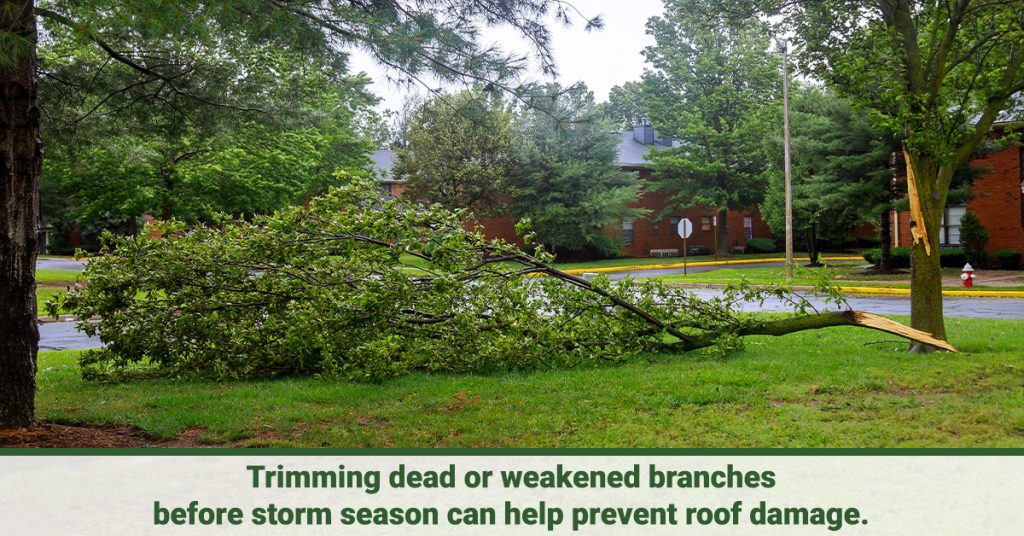
One of the simplest ways to reduce wind damage risk starts in your yard. Trimming dead or weakened branches before storm season can help prevent roof damage since high winds can easily turn them into airborne debris capable of damaging roofs, siding, and windows.
Regular tree maintenance helps reduce the chance that a heavy limb ends up puncturing shingles or damaging flashing during a storm. As a rule, branches should be kept several feet away from your roofline to prevent both impact damage and repeated scraping during gusty conditions.
Proactive trimming can help protect your roof and reduce the likelihood of a preventable insurance claim after severe weather.
6. Garage Door Reinforcement
Your garage door might not be the first thing you think about when it comes to roof protection, but it plays a bigger role than most homeowners realize.
Garage doors are typically the largest opening in a home. If high winds cause that door to buckle or blow inward, wind can rush into the structure and rapidly increase internal pressure. That added pressure pushes upward on the roof from inside, intensifying uplift forces and increasing the likelihood of roof failure.
Because of this risk, FEMA’s wind mitigation guidance recommends reinforcing garage doors in wind-prone regions, especially for homes exposed to severe thunderstorms, nor’easters, or hurricane-force winds.
Reinforcement options can include upgraded bracing kits, impact-rated doors, or replacing older doors with wind-rated models designed to withstand higher pressure loads. Strengthening this single component can significantly reduce the chance of broader structural damage during a major storm.
Insurance Considerations: What’s Typically Covered?
Every policy differs, but sudden wind damage, missing shingles from a documented storm, and interior damage caused by covered wind event are typically covered.
However, wear and tear, deterioration, long-term seepage, and neglect are generally not covered.
If a 20-year-old roof fails due to age, that may not qualify as sudden wind loss.
Wind/Hurricane Deductibles
In some regions, separate wind deductibles apply. Review your declarations page or speak with your agent to understand your exposure.
Claims Tips
- Report promptly
- Avoid signing repair contracts before claim review
- Keep all receipts
- Ask questions about scope and depreciation
Special Considerations for New England Homes
New England brings unique combinations to homeowners such as nor’easters with sustained winds, heavy snow loads, ice dams, and freeze-thaw cycles.
Older homes with plank decking, inconsistent nail spacing, or multiple roof layers may be at higher risk because these factors can increase vulnerability even at moderate wind speeds.
Common Myths About Wind Damage
Myth: If shingles aren’t missing, I’m fine.
Reality: Lifted or creased shingles may fail later.
Myth: Only hurricanes cause real damage.
Reality: Severe thunderstorms exceed 58 mph regularly (NOAA).
Myth: My roof is new, so I don’t need inspection.
Reality: Installation quality matters as much as age.
Myth: Insurance covers everything.
Reality: Maintenance-related deterioration typically isn’t covered.
Final Thoughts
Wind damage rarely announces itself dramatically. The best protection is strong installation, routine inspection, prompt documentation, and a clear understanding of your coverage.
If you’ve recently experienced strong winds, even if your roof “looks fine,” a professional inspection can provide peace of mind.
If you’re unsure how wind coverage applies to your home, a quick conversation with your insurance agent can clarify what’s protected and what’s not before the next storm rolls through.
Need to learn more about how your homeowners insurance can protect you from winter storms?
Our agents are ready to help, so contact us to learn how we can customize your insurance policies to meet your needs.
*Disclaimer: We offer content for informational purposes; Co-operative Insurance Companies may not provide all the services or products listed here. Please get in touch with your local agent to learn how we can help with your insurance needs.
Sources
American Society of Civil Engineers. Minimum Design Loads and Associated Criteria for Buildings and Other Structures (ASCE 7).
https://www.asce.org/publications-and-news/asce-7
International Code Council. International Building Code (IBC) 2021 Edition.
https://codes.iccsafe.org/content/IBC2021P1
National Oceanic and Atmospheric Administration (NOAA). Thunderstorm Safety: Damaging Winds. https://www.noaa.gov/jetstream/wind_damage
National Oceanic and Atmospheric Administration (NOAA). Wind Safety and Preparedness.
https://www.weather.gov/safety/wind
Insurance Institute for Business & Home Safety (IBHS). FORTIFIED Roof™ Standards.
https://fortifiedhome.org/roof/
Insurance Institute for Business & Home Safety (IBHS). Wind Research Overview.
https://ibhs.org/research-center/wind/
WBUR. Blizzard of 2026 recap: Record snow totals and hurricane force winds.https://www.wbur.org/news/2026/02/24/blizzard-2026-snow-totals-winds