

Imagine that you’re about to start a new project. The contract is signed, the schedule is set, and you’re ready to get to work.
Then an email arrives saying, “Before work begins, please provide your Certificate of Insurance.”
For some business owners, that request can trigger a scramble.
What exactly is a Certificate of Insurance? Do you already have one? Does it require special paperwork? And why is your client asking for it in the first place?
Whether you’re a contractor, consultant, property manager, retailer, manufacturer, or service provider, chances are you’ll eventually be asked to provide a Certificate of Insurance (COI). While it may seem like just another administrative task, understanding how COIs work can help you avoid project delays, contract issues, and unnecessary headaches.
In this guide, we’ll cover what a Certificate of Insurance is, why clients request them, and what it all means for you. Let’s dive in.
Topics Covered
- What Is a Certificate of Insurance (COI)?
- Why Do Clients Request Certificates of Insurance?
- What Does “Additional Insured” Mean?
- Understanding Contract Insurance Requirements
- Before You Send a COI: Common Mistakes That Can Create Big Problems
- Real-World Example: The Last-Minute Contract Problem
- What a COI Does—and Does Not—Prove
- Best Practices for Managing Certificates of Insurance
- When Should You Contact Your Insurance Agent?
What Is a Certificate of Insurance (COI)?
A Certificate of Insurance, commonly called a COI, is simply a document that provides a summary of your insurance coverage. It serves as proof that your insurance policies are currently in force and provides basic information about those policies.
A COI is typically issued by your insurance company or insurance agent and is often requested before work begins, contracts are finalized, or access is granted to a job site or facility.
A typical Certificate of Insurance may include:
- General liability insurance
- Commercial auto insurance
- Workers’ compensation coverage
- Umbrella or excess liability coverage
- Policy limits
- Policy numbers
- Effective and expiration dates
- Insurance carrier information
One crucial point that many business owners misunderstand is that a COI is not the insurance policy itself.
The certificate summarizes coverage, but it does not change your policy language, add coverage, or modify the terms of your insurance contract. The actual policy remains the controlling document.
Think of a COI as a snapshot of your coverage at a specific point in time and not the complete insurance agreement.
Why Do Clients Request Certificates of Insurance?
From a client’s perspective, hiring a company brings risk.
If a contractor damages property, a vendor causes an accident, or a subcontractor’s employee is injured on a job site, the hiring company may be exposed to legal and financial consequences.
A Certificate of Insurance (COI) helps clients verify that the businesses they work with maintain appropriate insurance coverage.
COIs are commonly requested for:
- Construction projects
- Property maintenance agreements
- Commercial leases
- Vendor contracts
- Municipal projects
- Professional service agreements
- Special events and trade shows
When requesting a certificate, clients are trying to confirm that you have:
- Active insurance coverage
- Adequate liability limits
- Workers’ compensation coverage when required
- Coverage that will remain in force throughout the project
In many cases, simply having insurance isn’t enough. The contract may also require specific endorsements or additional protections, which brings us to one of the most common COI-related requests.
What Does “Additional Insured” Mean?
If you’ve reviewed a contract and seen the phrase additional insured, you’re not alone. It’s one of the most frequently requested insurance requirements in commercial contracts.
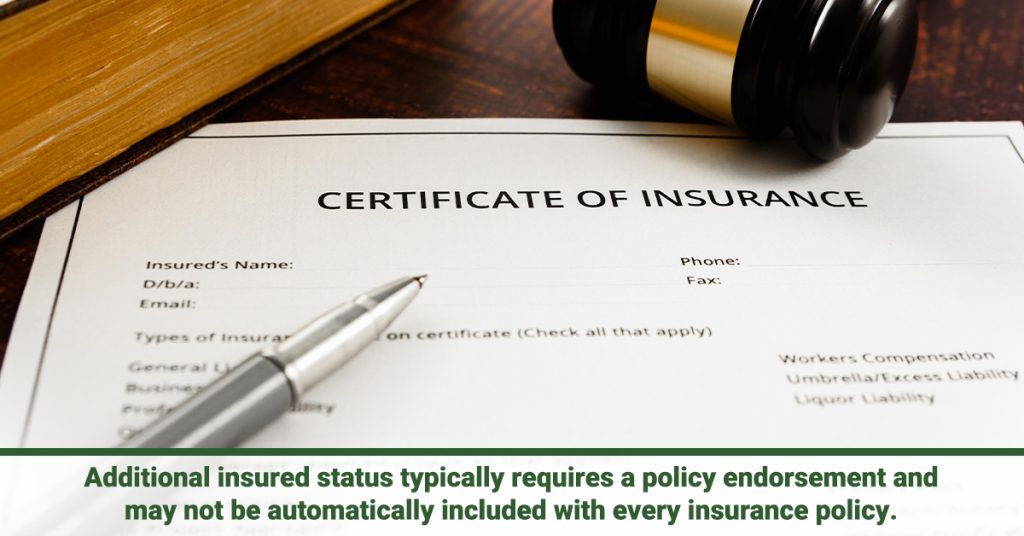
An additional insured is a person or organization that is added to another party’s insurance policy through an endorsement. This may provide certain liability protections related to the named insured’s operations, subject to the policy’s terms and conditions.
A Real-World Example
Imagine a contractor is hired to renovate a commercial office building.
The building owner wants protection if a claim arises from the contractor’s work. As part of the contract, the owner requires the contractor to name the ownership entity as an additional insured under the contractor’s general liability policy.
If a covered claim arises from the contractor’s operations, the additional insured endorsement may provide certain protections to the property owner, depending on the circumstances and policy language.
It’s important to understand that additional insured status is not automatically included in every policy. Depending on the policy and the contract requirements, specific endorsements may be necessary.
If a contract requests additional insured status, it’s always wise to review the requirement with your insurance professional before signing.
Understanding Contract Insurance Requirements
One of the most common mistakes businesses make is assuming that proof of insurance is the only requirement in a contract. Many contracts contain detailed insurance provisions that go far beyond simply showing that a policy exists.
Common requirements may include:
- Minimum liability limits
- Additional insured status
- Waiver of subrogation
- Primary and noncontributory wording
- Workers’ compensation coverage
- Umbrella or excess liability coverage
- Specific policy endorsements
Some contracts may require limits that exceed your current coverage. Others may require endorsements that aren’t included automatically with your policy.
The challenge is that many business owners don’t discover these requirements until after the contract has already been signed. At that point, there may be additional costs, processing delays, or coverage adjustments needed before work can begin.
Best Practice
Review insurance requirements before signing a contract whenever possible. A quick conversation with your insurance agent before committing to the agreement can help identify potential issues early and avoid surprises later.
Before You Send a COI: Common Mistakes That Can Create Big Problems
Certificates of Insurance seem straightforward, but a few common mistakes can create significant problems for business owners.
Mistake #1: Waiting Until the Last Minute
Insurance documentation is often treated as an afterthought. A client requests a certificate the day before a project starts, and suddenly everyone is rushing to gather paperwork, request endorsements, and verify requirements.
While many certificates can be issued quickly, endorsements and policy modifications may take additional time.
Planning ahead helps prevent unnecessary delays and keeps projects on schedule. Keep your COI on hand as a digital file so you can quickly send it whenever you need to.
Mistake #2: Assuming the COI Changes Coverage
Many people mistakenly believe that whatever appears on a certificate automatically creates or modifies coverage, but that’s not how a COI works.
A certificate summarizes existing coverage but doesn’t:
- Increase policy limits
- Add endorsements
- Expand coverage
- Modify policy language
- Change contractual obligations
The insurance policy itself determines what is and is not covered.
Mistake #3: Ignoring Contract Requirements
A Certificate of Insurance can be completely accurate while still failing to satisfy the contract. For example:
- Required liability limits may be too low
- Additional insured wording may be missing
- Required endorsements may not be included
- Specific coverage requirements may not be met
Simply providing a certificate doesn’t guarantee compliance with the agreement.
Mistake #4: Providing an Outdated Certificate
Clients want confirmation of current coverage and submitting an expired certificate can create delays and raise questions about whether your insurance remains active.
Before sending a COI, verify that all policy information and dates are current.
Mistake #5: Allowing Coverage to Lapse During a Project
Some projects last months or even years but maintaining active coverage throughout the project period is often a contractual requirement.
Tracking policy renewal dates and updating and providing certificates as needed can help prevent compliance issues down the road.
Real-World Example: The Last-Minute Contract Problem
Imagine that you’re a local contractor who just landed a significant commercial project and you’re eager to begin work. The contract requires:
- $2 million general liability limits
- Additional insured status
- Waiver of subrogation
- Proof of workers’ compensation coverage
You’re excited to move forward, so you sign the agreement and focus on scheduling crews and ordering materials. Two days before the project starts, the client asks for insurance documentation, and that’s when you realize several required endorsements are missing.
Uh-oh! Now you have to rush to contact your insurance agent, request endorsements, verify coverage limits, and satisfy the contract requirements before work can even begin.
Result: Your project start date is delayed while the documentation is finalized, costing you time and money.
The Lesson
Insurance requirements are usually much easier, and often less expensive, to address before signing the contract rather than after deadlines are already approaching. A brief review upfront can save you considerable time and frustration later.
What a COI Does and Does Not Prove
Understanding the limitations of a Certificate of Insurance is just as important as understanding its purpose.
A COI Proves:
- Insurance coverage existed when the certificate was issued
- Policies were active on the date shown
- Coverage limits listed on the certificate
- Basic policy information
A COI Does Not Prove:
- Every future claim will be covered
- All contract requirements have been satisfied
- Additional insured status automatically exists
- Coverage cannot change or be cancelled later
- The certificate holder has rights under the policy
A COI should be viewed as a summary document and not a guarantee of coverage outcomes.
Best Practices for Managing Certificates of Insurance
Fortunately, managing COIs isn’t complicated, and a few simple habits can prevent most common issues.
Build a Simple COI Process
Consider implementing the following best practices:
- Review insurance requirements before signing contracts
- Request certificates early in the process
- Communicate proactively with your insurance agent
- Keep organized records of certificates and endorsements
- Track policy renewal dates
- Verify contract requirements before work begins
- Maintain copies of all relevant documentation
These steps can help reduce delays, improve compliance, and make future certificate requests much easier to manage.
When Should You Contact Your Insurance Agent?
You don’t have to navigate contract insurance requirements alone.
Contact your insurance agent whenever:
- A contract contains unfamiliar insurance language
- Additional insured status is requested
- Higher liability limits are required
- Special endorsements are requested
- You’re bidding on larger projects
- You’re unsure whether your current coverage meets contractual requirements
A quick review before signing an agreement can often identify potential issues before they become expensive problems.
Final Thoughts
Certificates of Insurance may seem like routine paperwork, but they play a key role in business relationships, contract compliance, and risk management.
Understanding what a COI does and doesn’t do can help your business avoid delays, meet contractual obligations, and maintain strong relationships with clients, vendors, and project partners.
By reviewing insurance requirements early, maintaining organized documentation, and working closely with your insurance professional, you can approach certificate requests with confidence and keep your projects moving forward smoothly.
If you’ve received a request for a Certificate of Insurance or have questions about your business insurance coverage, the team at Co-op Insurance is here to help. We’ll work with you to understand your options, review contract requirements, and make sure you’re prepared for opportunities when they arise.
Need to learn more about your Certificate of Insurance (COI)?
Our agents are ready to help, so contact us to learn how we can customize your insurance policies to meet your needs.
*Disclaimer: We offer content for informational purposes; Co-operative Insurance Companies may not provide all the services or products listed here. Please get in touch with your local agent to learn how we can help with your insurance needs.
Sources
GEICO. What Is a Certificate of Insurance (COI)? Definition, When It’s Needed, and How to Verify. https://www.geico.com/information/aboutinsurance/business/what-is-a-certificate-of-insurance-coi/
Get Jones. COI Certificates Explained: What to Look for on an ACORD Form
https://getjones.com/blog/coi-certificates-explained-what-to-look-for-on-an-acord-form/
Progressive Commercial. What is a certificate of insurance for contractors?
https://www.progressivecommercial.com/business-insurance/certificate-of-insurance-for-contractors/
The Hartford. Certificate of Liability Insurance.
https://www.thehartford.com/general-liability-insurance/certificate-of-liability-insurance